
What We Handle
Garage door springs counteract the heavy weight of the door sections, allowing the opener or a human to lift the door easily. Because springs operate under extreme mechanical tension, they will fatigue and snap over time, rendering the door inoperable.
Signs Your Garage Door Spring May Be Broken
When a high-tension steel spring snaps under load, it creates a loud, metallic gunshot-like sound that echoes through the home.
Without the spring's counterbalance, a standard door weighs 150 to 300+ pounds, making it nearly impossible to lift by hand.
Automated openers are designed to lift balanced weight. If a spring breaks, the opener's safety limits will trigger, stalling the motor.
Torsion springs are mounted on a shaft above the door. When they snap, a clear 1 to 2-inch separation appears in the coil coils.
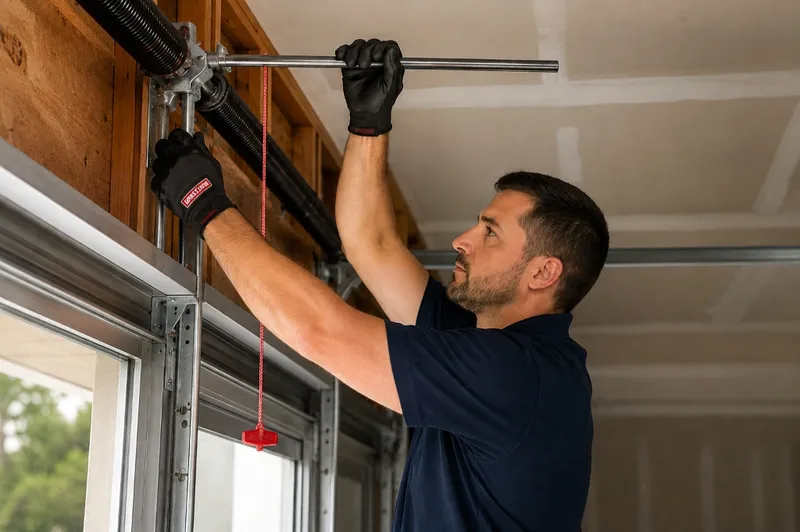
Garage doors utilize either torsion springs (mounted on a shaft above the opening) or extension springs (mounted along the tracks). Replacing these systems involves handling high stored energy. Homeowners should never attempt to adjust, wind, or remove high-tension springs without proper safety tools and training, as snaps can cause severe damage or injury.
What Happens During a Spring Service Call
We unplug the opener and secure the door sections using lock grips to prevent sudden drops.
We safely unwind any remaining tension in the companion spring using professional winding bars.
We slide the shaft out, remove the broken coils, install the correctly rated spring, and secure the brackets.
We wind the new spring to the correct tension, lift the door manually to verify balance, and test safety points.
Our Service Process
Why StormForge
All work is done by background-checked, fully trained employees of StormForge Garage Doors.
We diagnose, present choices, and write a fixed quote before any wrench touches your door.
Call or text us 24/7 - we'll confirm the soonest same-day arrival window based on technician availability in your area.
License #CRC1334692
Frequently Asked Questions
Q: How can I tell if my garage door spring broke?
Look above the closed door for a visible gap of 1-2 inches in the tightly wound torsion spring. Other signs include a loud bang, the door refusing to lift more than a few inches, or the door feeling extremely heavy.
Q: Can I open a garage door with a broken spring?
You should not attempt to open the door, either by hand or with the opener. Doing so puts excessive strain on the opener motor (which can burn out) and risks dropping the heavy door panel suddenly.
Q: Why did my garage door spring break?
Springs fatigue over time due to metal stress. Many standard residential springs are rated around 10,000 cycles, while other spring configurations may have different cycle ratings. Actual service life depends on the spring, door system, frequency of use, and operating conditions.
Q: Do both springs need replacement if only one is broken?
Yes, we strongly recommend replacing both springs. Since they were installed at the same time and have experienced the same number of cycles, the unbroken spring is under similar metal fatigue and will likely break shortly after the first.
Q: How long does a garage door spring last?
A spring's service life is determined by its cycle rating. Standard residential springs often last 5 to 9 years depending on daily usage, while high-cycle replacements can offer a significantly longer operational lifespan.
Q: Are torsion and extension springs different?
Yes. Torsion springs are mounted on a bar above the door and distribute weight evenly by twisting. Extension springs run parallel to the horizontal tracks and stretch. Torsion systems are generally safer and more durable.
Service Dispatch Cities
We dispatch mobile service trucks daily throughout these Southwest Florida cities: